Cornhole: complete guide to rules, distances & techniques
Cornhole – also known as the cornhole game – is taking over the UK and Europe. This tossing game with wooden boards and filled bags is perfect for the garden, camping, corporate events and serious tournaments.
On this page you’ll find our official Cornhole knowledge centre: all cornhole rules, distances, techniques, variations and tips in one place. And of course: the best sets to start right away, from casual play to professional ACL-standard gear.

What is Cornhole?
Cornhole is a tossing game where players take turns throwing filled fabric bags towards a raised wooden board with a hole. A bag in the hole scores 3 points, a bag that stays on the board scores 1 point. Anything that hits the ground does not count.
The game is easy to explain but surprisingly strategic. You can both attack and defend, and with smart throws you control the board, the score and the flow of the game.
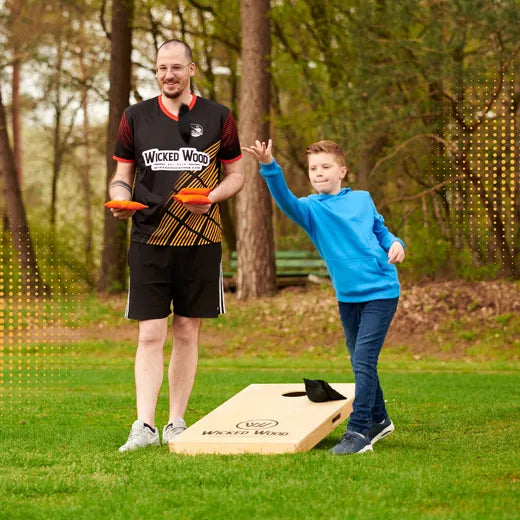
Across the UK and Europe, Cornhole is quickly becoming the go-to outdoor garden game for gardens, campsites, festivals and corporate events. You can play 1 vs 1 or in teams of 2 vs 2 – ideally with a drink in hand and a healthy dose of competition.
Want to see the official cornhole rules in detail?
View the full Cornhole rules & distances here.

Cornhole rules – official basics at a glance
The official cornhole rules in Europe largely follow the standards of the American Cornhole League (ACL). Here are the basics at a glance:
- Teams: 1 vs 1 (singles) or 2 vs 2 (doubles).
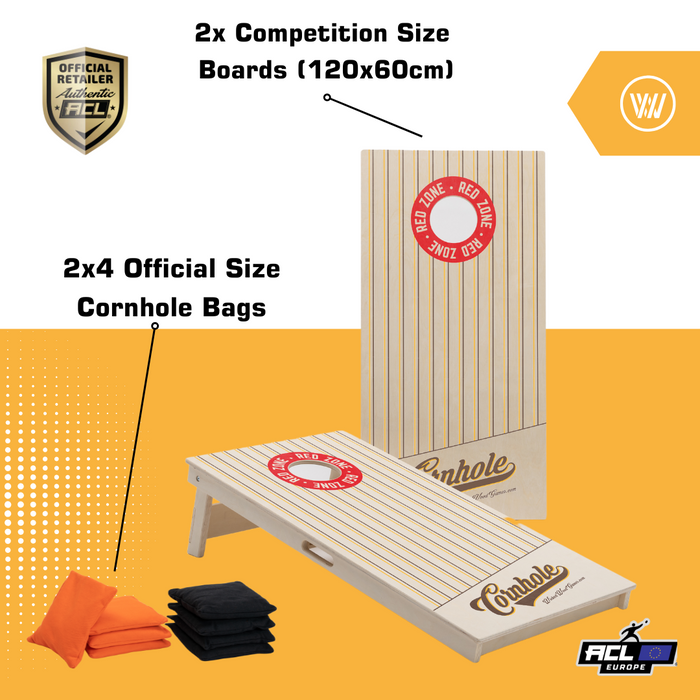
- Bags: each team plays with 4 bags in its own colour or design.
- Throws: underhand only, from behind the front edge of your board (foul line).
- Points:
- Bag in the hole: 3 points
- Bag on the board: 1 point
- Bag on the ground / off the board: 0 points
- Cancellation scoring: at the end of the round, the points cancel each other out and only the difference is added. If Team A scores 7 points and Team B 4, Team A gets 3 net points (7 – 4 = 3).
- Objective: the first team to reach (or depending on the variant, exceed) 21 points wins the game.
All exceptions, fouls, tournament rules and “backyard” variants are explained on our dedicated Cornhole rules page.
Official Cornhole distances & playing field
For a true Cornhole experience it’s important to set up the cornhole boards and distance correctly. These are the guidelines:
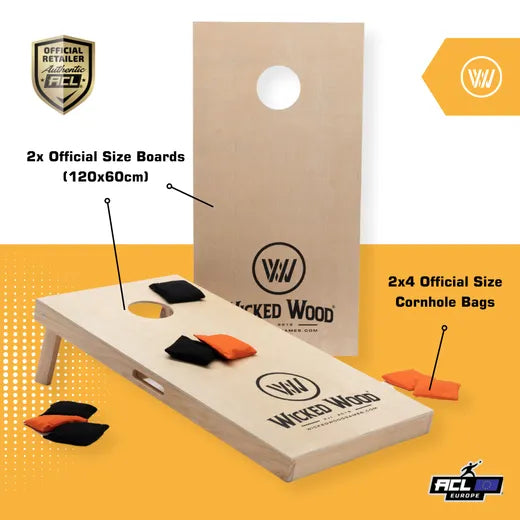
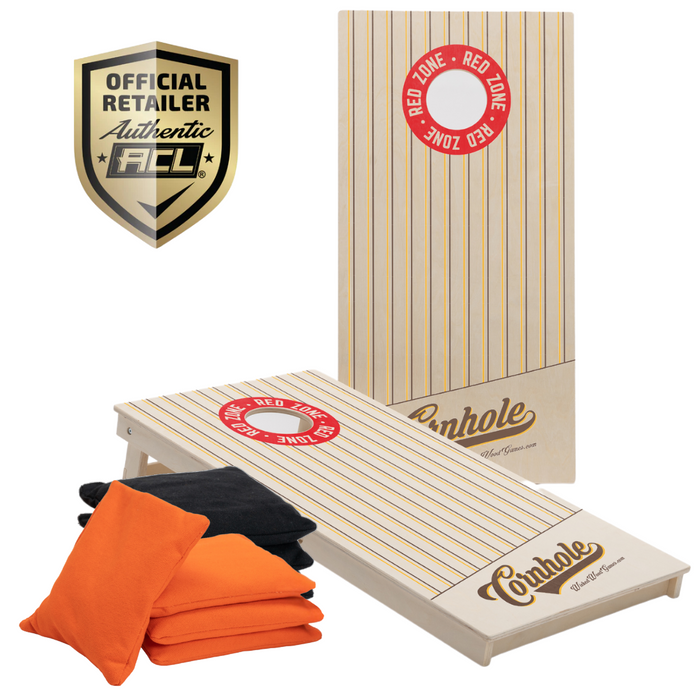
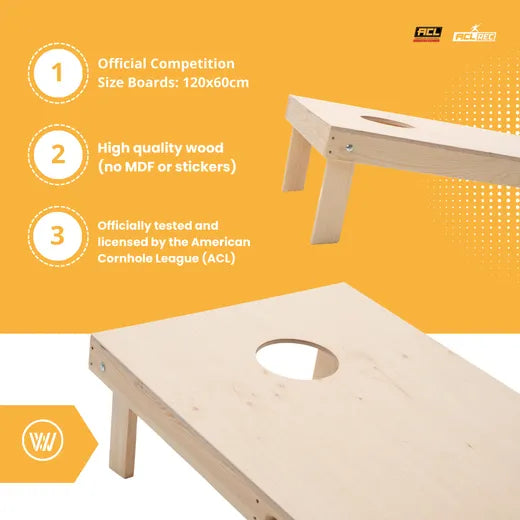
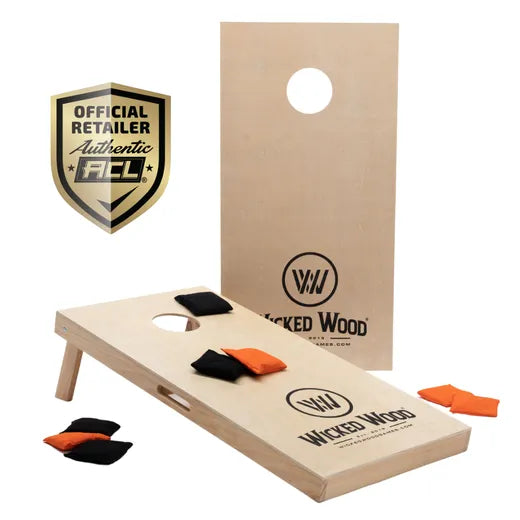
- Board size: official boards are approximately 120 × 60 cm (48 × 24 inches).
- Hole diameter: about 15 cm (6 inches), centred horizontally.
- Hole position: centre of the hole about 23–24 cm from the top of the board.
- Height: front edge around 8–10 cm high, back around 30 cm high, creating a gentle slope.
- Official cornhole distance: the fronts of both boards are 8.23 metres (27 ft) apart for adults.
- Youth / recreational: for children or casual play you can easily use a shorter cornhole distance of 5–6 metres.
Also make sure the ground is as flat as possible and that there’s enough space on the sides so players can move and throw freely. More information about cornhole distances and board measurements.
Cornhole boards & bags – materials & choices
Good equipment makes the cornhole game fairer, more fun and more consistent. At Wicked Wood Games we work with boards and bags that follow international standards.
Boards
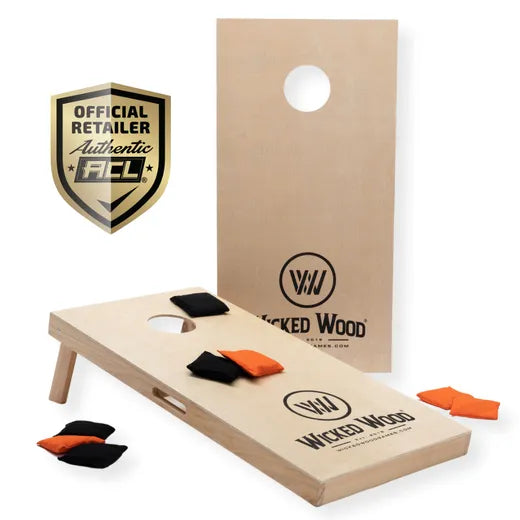
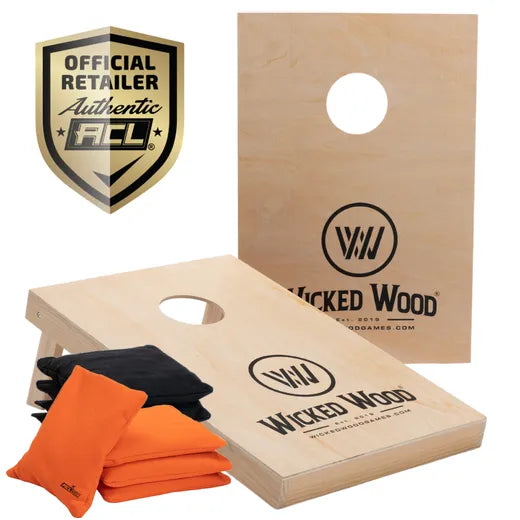
- Size: official boards of approx. 120 × 60 cm, plus more compact 90 × 60 cm models for kids or smaller spaces.
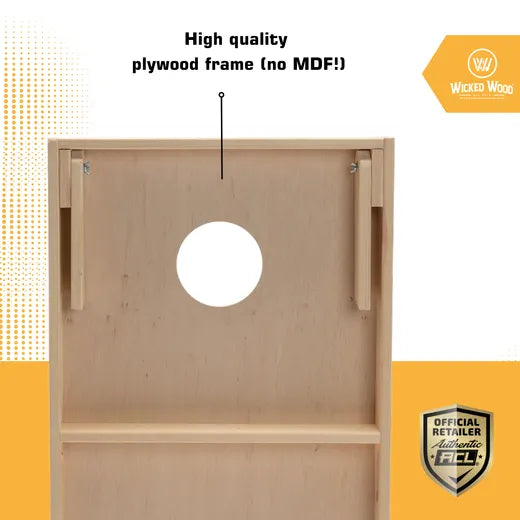
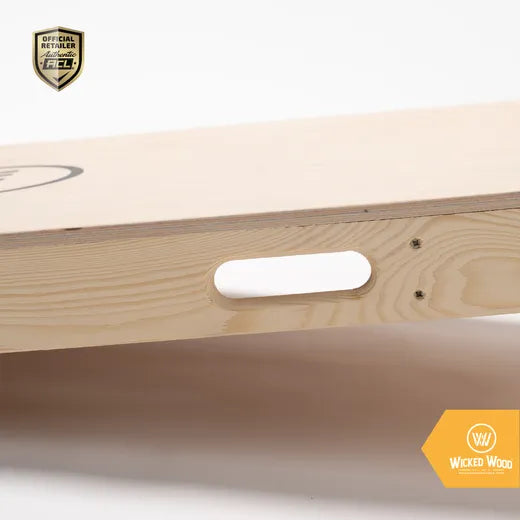
- Material: European wood for a stable and durable playing surface.
- Finish: smooth enough to let the bags slide, but with enough grip so they don’t shoot straight off.
- ACL-ready: many of our sets meet ACL specifications for recreational or competitive play.
Bags
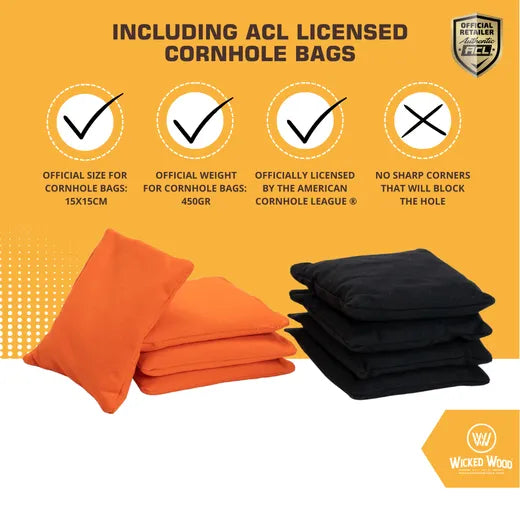
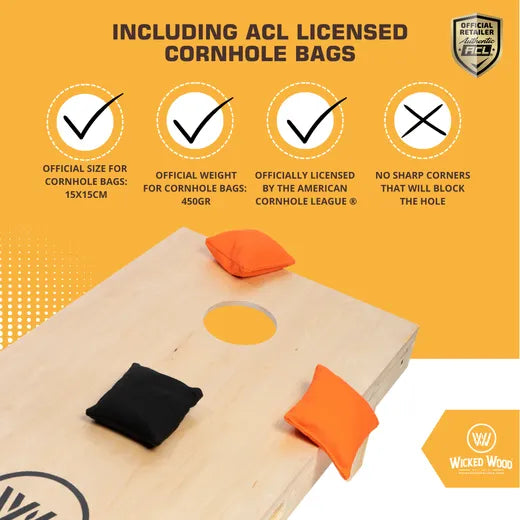
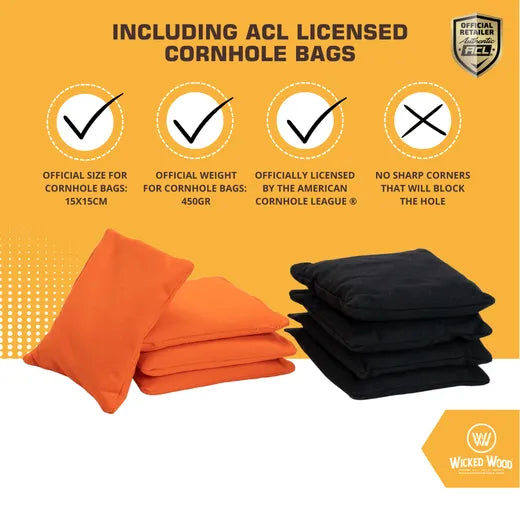
- Weight: around 450 grams per bag.
- Fill: corn or plastic pellets (resin); resin is more durable and weather-resistant.
- Fabric: strong fabrics with a good balance of grip and slide.
- Design: solid colours, patterns or fully custom with your own logo or branding.
View all Cornhole sets or all Cornhole bags. Or check our Cornhole bag buying guide.
Technique & throws – how to throw better bags
In the cornhole game everything is about control. With a bit of attention to technique you will start throwing better almost immediately.
- Stance: place your feet solidly, sideways or straight behind the foul line. Find a position where you feel relaxed.
- Grip: hold the bag on one side so it lies flat in your hand. Don’t squeeze it too hard.
- Arm motion: a smooth underarm swing without jerking at the end. Think of a pendulum.
- Release: let go of the bag around the top of the swing with a slight forward rotation.
- Aim point: aim for the front third of the board so the bag can slide nicely towards the hole.
Try to practise at the official cornhole distance of 8.23 metres. If you can score consistently from there, every shorter distance will feel much easier.
Visit our dedicated page about different cornhole techniques.
Strategy & tactics – from casual game to smart play
Cornhole is more than “just aim at the hole”. With some simple cornhole strategy you can quickly start winning more games:
- Attack vs defence: if you’re behind, aim more aggressively at the hole. If you’re ahead, use more blockers to make it harder for your opponent to score.
- Block shot: place a bag just in front of the hole. That makes it much harder for your opponent to throw straight in.
- Push shot: already have a bag on the board but not in the hole? Throw another bag into it to push it in.
- Airmail: when the board is crowded or blocked, try a throw that goes straight into the hole without hitting the board first.
- Score management: sometimes it’s smarter to take a safe 1 point and deny your opponent points than to risk everything for 3.
By consciously choosing between attacking, blocking or playing safe each turn, the cornhole game becomes a strategic battle that never gets boring. Check out our other cornhole strategy tips.
Game variations – Cornhole for every level and occasion
The official cornhole rules are perfect for competition, but for parties and family days you can make things more relaxed. Some popular variations:
- Backyard Cornhole: shorter distance (5–6 m), play to 15 or 18 points instead of 21, and sometimes without cancellation scoring.
- Kids mode: lighter board, shorter distance and every bag on the board or in the hole counts fully.
- Speed Cornhole: both teams throw at the same time within a time limit. Ideal for tournaments with many teams.
- King of the Hill: win your game and stay on the board. Challengers move up to face the winner.
- Team relay: with larger groups, let each player throw one bag in turn and total the team score after a round.
Of course, you can also create your own house rules as long as everyone knows what they are before you start. See all cornhole scoring variants in detail. New to cornhole? Have a look at our beginner’s guide.
Cornhole tournaments & competition
The cornhole game is perfect for tournaments: fast, spectacular and easy to explain. Some basic principles:
- Formats: single elimination, double elimination, round-robin groups followed by knock-out, or a simple ladder competition.
- Game length: play to 21 points, or use a time limit and see who is ahead when time runs out.
- Singles vs doubles: 1 vs 1 gives more throws per player; 2 vs 2 adds more dynamics and team spirit.
- Planning: use a schedule, score sheets and clear rules to prevent discussions.
- Equipment: ideally use boards and bags with official cornhole measurements so everyone plays under the same conditions.
Organising a corporate tournament, club night or large event? We’re happy to help with sets, branding and setup. And click here for more information about organising a cornhole tournament.
Cornhole maintenance – keeping your boards & bags in top shape
The better your Cornhole boards and cornhole bags are maintained, the more consistent the game will feel. A well-finished board with the right slide and bags that don’t clump or hold moisture make a huge difference to your throw, technique and strategy.
In our Cornhole maintenance guide we explain how to:
- keep your boards clean and dry without damaging the finish
- clean cornhole bags properly (without washing or ruining them)
- store and transport equipment correctly and protect it from moisture and wear
- recognise when boards or bags need replacing
Many players wonder: “Can you wash cornhole bags?” The short answer is: preferably not. In this article you’ll read exactly why and what you can do instead: Washing cornhole bags – is it allowed?
If you want to get the most out of your game and enjoy your set for longer, combine high-quality cornhole sets with smart maintenance – then every game will feel familiar and predictable.
Cornhole glossary – learn all the official terms
The more you play, the more you’ll notice that the cornhole game is full of specific English terms and competition jargon. Expressions like airmail, blocker, slider and four bagger are used in almost every match or ACL tournament. Knowing these terms helps you understand the game better and also makes you tactically stronger in both casual games and official competitions.
That’s why we’ve created a comprehensive Cornhole Glossary with all important terms, techniques, throws, rules and competition jargon you need to know as a player. It’s a perfect reference for both beginners and advanced players who want to approach the game more professionally.
- Full explanation of all cornhole terms
- Official competition language from ACL events
- Technique terms, strategy concepts & scoring jargon
- Perfect reference for practice sessions and tournaments
Want to quickly check what a Woody is, how a Push Shot works or why a Skunk can end a game immediately?
Check our complete glossary here: Cornhole Glossary
History of Cornhole
The origins of the cornhole game lie in the United States, most likely in the Midwest, where farmers and families played it with simple wooden boards and bags filled with corn. From a simple tossing game it grew into a national phenomenon.
Over the past decades Cornhole has become increasingly professional, with televised tournaments, sponsorships and organisations like the American Cornhole League (ACL) managing official rules, rankings and competitions.
Building on that American tradition, Wicked Wood Games brought Cornhole to Europe. Our boards match internationally used cornhole distances and board sizes, so you can play both casually and at tournament level.
Want to know more? Read our article: Where did Cornhole originate?
Downloads & tools for players and organisers
Want to get started quickly with rules, scoring and tournaments? Use these tools (optionally filled with actual PDFs and links):
- Rulebook (PDF): complete overview of all official cornhole rules.
- Score sheet (PDF): printable scorecard for single games and tournaments.
- Distance & layout charts: overview of board and field measurements – ideal when setting up:
- Distance layout (English)
- Distance layout (French)
- Distance layout (German)
- Distance layout (Dutch)
- Distance layout (Swedish)
- Distance layout (Danish)
- Distance layout (Croatian)
- Distance layout (Italian)
- Distance layout (Spanish)
- Tournament planner: basic templates for groups, knock-out brackets and schedules.
- Quick Start Guide: a one-page summary of the key cornhole rules – ideal for corporate or family events. Choose your language:
- Quick Start Guide (English)
- Quick Start Guide (French)
- Quick Start Guide (German)
- Quick Start Guide (Dutch)
- Quick Start Guide (Swedish)
- Quick Start Guide (Danish)
- Quick Start Guide (Croatian)
- Quick Start Guide (Italian)
- Quick Start Guide (Spanish)
Why the cornhole game is so popular
- Low barrier to entry: everyone can join within a minute, regardless of age or level.
- Competitive: easy scoring system, but endless tactical depth.
- Social: perfect for drinks, BBQs, corporate events, festivals and campsites.
- Durable: solid wooden boards last for years.
- Personalised: with custom designs you can create sets for clubs, companies or weddings.
Frequently asked questions about Cornhole
What is Cornhole?
Cornhole is a tossing game where players throw filled bags towards a raised wooden board with a hole. A bag in the hole scores 3 points; a bag that stays on the board scores 1 point.
What is the official cornhole distance?
The official cornhole distance is 8.23 metres between the front edges of both boards. You’ll find more details on our Cornhole distances & measurements page.
How heavy are cornhole bags?
Official cornhole bags weigh around 450 grams each and are filled with corn or plastic pellets (resin). Resin is more durable and more resistant to moisture.
Which Cornhole set should I choose?
For the garden or camping a recreational set is perfect. If you want to move towards tournaments or competition, choose an official board size (120 × 60 cm) with professional bags and an ACL-standard board.
Can I play Cornhole outside?
Yes, playing cornhole outdoors is the most common. Make sure you have a flat surface, enough space to throw and ideally dry conditions for both the bags and the board.
What’s the difference between recreational and competitive Cornhole?
Recreational cornhole is flexible: you adjust distance, scoring and rules to the group, for example with shorter distances or a lower target score. Competitive Cornhole follows fixed official rules and measurements, is usually played at the full cornhole distance of 8.23 metres with 120 × 60 cm boards and uses equipment that meets competition standards such as those of the American Cornhole League (ACL).